
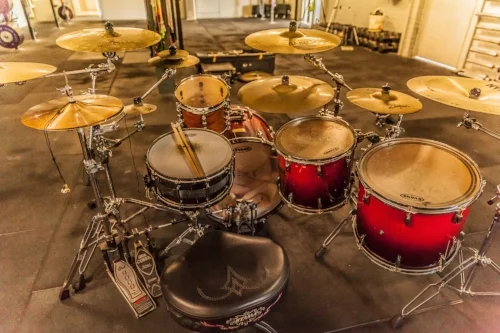
The practice schedule
I mention this to all my students all the time, PRACTICE is extremely important!
Even if you are just practicing at home, it’s extremely important. If you play drums with a band, jam with mates, or jam for fun, practice is important. Practice will enable you to become a better drummer and to progress further into the musical world!
It's very important along with drum lessons, that you allocate time behind the kit, or pad at home.
YOUNG STUDENTS
For younger students (12 and younger), I recommend first, to have FUN. This is most important thing to hardwire into a new drummer from day one. My lessons don't contain a heap of theory, and if there is any, I hide it with a fun attitude and different exercises on the drum pad, games, etc. Also, I sneak theory in when we play along to songs, or along to drum beats. For a new student, I encourage they hop on their drum kit almost every day, and either play for fun, or play along to songs.
If you wish for them to practice the drum homework I assign each week, that's great!
I would recommend 5 to 10 minutes of concentrated practice every day, or every 2nd day. Break this into the different homework parts I assign, and into 1 to 2, maybe 3 minute blocks. Then reward them with a song to play along with after a 5 minute block. Once they have had a chance to jam out – then get them back to it for another 2 to 5 minutes of concentrated work.
If you mix in fun with lesson homework, I believe they will love music for longer, and not see it as a chore!
Pay attention to what music they are listening to. If the younger student is drawn to a particular song on the radio – remember that song – then suggest to them, to play along with it at home for fun, or you could even bring that song into the drum room, and we can jam along to it!! Playing along with music, as mentioned above is extremely important for the development of the drummer’s sense of timing and musicianship.
Lastly, for a younger student, show an interest in their instrument. Help them out by googling a drummer, drum videos, or finding a song for them to jam to, even going to the point of helping them with their drum homework. Jam along with them :-D Make the drums fun!
Here is my youtube site for interest: https://www.youtube.com/channel/UCT2OiouZFsQVEOpZ1xck8og
MATURE STUDENTS
All I have said above still applies, but for the older student, more focused practice regime is a MUST! Good concentrated practice, no distractions.
I recommend 30 minutes to 60 minutes every day, and even up to over an hour. If there is a fortnight gap between lessons, then I would say every day to 2nd day practice.
repetition, patience & consistency!
Most times I practice, I start on rudiments. This acts as a warm-up before moving onto more complicated rudiment work or even the drum kit. But if you feel this is becoming a bore after a little while, always remember to keep it fresh. Practice rudiments on the kit instead of the pad for example.
Start on the drum kit first perhaps. Move from the pad, then to the kit, and then back again. Break up your practice with songs, or just jamming/improvising on the kit.
Another important part of drumming, especially when you mature as a drummer, is to play to a metronome (click track). MOST times I practice I have a metronome on. This enables perfect timing, sharpness of your playing, and builds confidence as a drummer to be able to play slow, medium, fast, extremely fast, etc. Ask any drummer – a click track is a must.
Break up your practice:
- practice with a metronome
- practice without a metronome (to help build your own body clock)
- practice with music (play your rudiments/drum grooves to some of your favourite songs)
WHAT ELSE?
Read Music
With my drum lessons each student is given a sheet with drum music on it, letting them know which part of the drum kit belongs to which line on the stave. All my pieces of sheet music are exercises on how to read music, and sharpen that skill-set.
KEEP A Drum Diary
It is a GREAT "look back" tool, at where you have come from, and what you have accomplished. Also, it's a great Indicator for the teacher (to see progress) and also to you, to see progress and confidence.
If you would like more information on what type of drum diary to keep, let me know.
Please remember, this is just a very brief run down on my thoughts of drum practice. Every student is different, and not on plan will fit for all. Try new things, asks me, the teacher questions about practice, sit on some lessons – see how the lesson runs. I strongly believe though – any age, make the drums / music – FUN :-D